Written by Emily Morrison
Supervisor: Dr Daniel Hourigan
6th May 2021
The New Weird is a hybrid genre of science fiction, horror, and fantasy, estranged from traditional conventions by creating indefinable, unexplainable, and inexplicable events and creatures. The conventions used in New Weird fiction are both definable and indefinable, as one might argue that when writing Weird Fiction, the only rule is to make it ‘weird’. Nevertheless, three aspects of The Weird have been briefly explored to appreciate how they fit into the fictional conventions of New Weird. Investigated within this paper will be the New Weird monster, New Weird’s subversion of genre, and the effectiveness of the unknowable.
Weird monsters take form in the tentacle, formless, oozing, gigantic, and indescribable shapelessness—unlike traditional gothic monsters. China Miéville claims that ‘The Weird – and its monsters – are categorically other, fundamentally opposed to that, neither knowable nor recalled’ (2012 p. 380). Traditional Weird monsters, such as Cthulhu, are written as malevolent enemies, whereas New Weird fiction takes a different approach, often blurring the definitions between enemy and friend, good and evil. Rather, New Weird monsters are used as catalysts for ‘important emotional reactions when confronting Anthropocene issues’ as Gry Ulstein argues, (2017 p. 74), where the focus is on humanity’s position. Chana Porter’s debut novel The Seep (2021) exemplifies how a weird monster can be both beneficial to humanity (in this case, aliens healing environmental damage, etc.), as well as oppressive (in The Seep’s case, curbing certain freedoms by providing endless freedom). New Weird monsters are considerably more than just monstrous figures serving as an antagonist. They instead encourage the reader to question and reflect their own thoughts and positions surrounding Anthropocene concerns. As with traditional monsters, New Weird fiction subverts traditional conventions in order to create a distinctly unique kind of monster and subsequential narrative.
New Weird also destabilises established conventional frameworks of genre, by combining the likes of science fiction, horror, supernatural, and fantasy, etc. into a hybrid genre, creating an entirely individual reading experience as a result. Benjamin Noys and Timothy S. Murphy claim that,
weird fiction plays with the conventions of fiction to expose us to the “shivering void” and to reveal those conventions as poor and desperate attempts to ward off that void. In so doing, weird fiction generates its own distinctive conventions and its own generic form, but it remains an unstable construction (2016, p. 117).
By way of exemplifying this, New Weird adopts radical ideas and challenges traditional normalisations of fiction to reveal emotions, reactions, and reflections from the reader that cannot be equally evoked through traditional conventions. Ann and Jeff VanderMeer write that ‘The Weird is as much a sensation as it is a mode of writing’ (2010) and thus is increasingly more difficult to categorise as conventional works of fiction are. Because New Weird occupies simultaneous genres, it can exist in the space of the in-between. Therefore, the subversion of genre both creates an entirely new one within fiction, while at the same time placing it into a kind of limbo-esque void of regulation. The unknown of New Weird applies to both its classification, as well as its content often using the indefinable and unknowable throughout its texts.
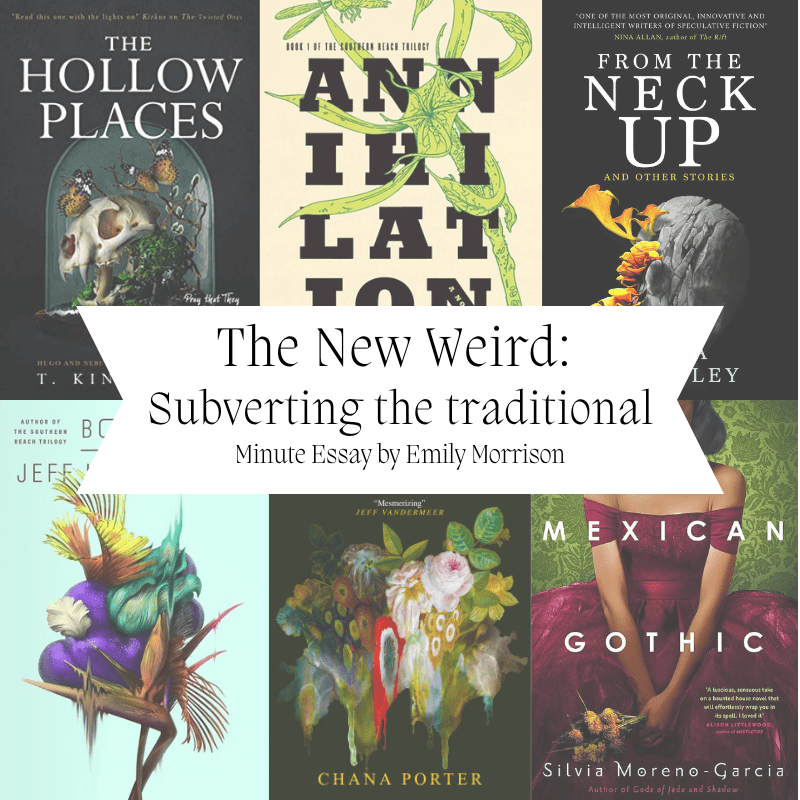
Often New Weird is somewhat recognisable due to a place, creature, object, or experience that is described as unexplainable. From Lovecraft’s Cthulhu initially communicated as ‘The Thing cannot be described – there is no language for such abysms of shrieking and immemorial lunacy, such eldritch contradictions of all matter, force, and cosmic order’ (2016 p.59), to Porter’s Seep creatures described as a ‘metallic tinge’ and ‘oily sensation’ (2021 p. 16), but never given a physical shape. The essence of ‘otherness’, ‘unseen’, ‘unexplainable’, and ‘stranger than’ is a consistent feature in New Weird Fiction. Miéville says that through radical otherness ‘The Weird is the assertion of that [which] we did not know, never knew, could not know, that has always been and will always be unknowable’ (2012, p. 380). Jeff VanderMeer, in his 2014 novel Annihilation, challenges the known and knowable of all his botanist’s senses. When confronted with the creature she calls ‘the Crawler’, it is described as sounds, images, and lights, shifts and movement, that takes on characteristics and descriptions so constantly changing ‘as if to mock my ability to comprehend it’ (VanderMeer 2014, p. 176). It is so incomprehensible that the botanist cannot provide readers with a distinct description. In most works, New Weird does not provide explanations, nor attempts to solve the unknowable, rather it demonstrates how reality, like unreality, is not always quantifiable, explicable, or knowable. It is the unknowable that generates the greatest impact with New Weird fiction.
New Weird fiction is in essence weird as a whole. It rejects traditional conventions, creating its own convoluted standards, and becomes something other and unique. The New Weird challenges traditional monsters by causing reflection and comparison with humanity rather than making them a source of antagonism. Subverting traditional tropes, such as the monster trope, adds to the conflict of classification, causing New Weird to fall both in its own unique genre and the spaces between previously established categories. New Weird’s sense of elusiveness is consistently found within, as well as without. Its fiction crafts an impactful, yet utterly unexplainable reading experience. Thus, three key conventions used in creating this kind of fiction are the New Weird monster, New Weird’s subversion of genre, and the use and effectiveness of the unknowable.
References
Lovecraft, HP 2015, ‘The Call of Cthulhu’, in ST Joshi & J Coulthart (eds), The Complete Cthulhu Mythos tales, Barnes & Noble, New York, Ny, pp. 36–61.
Miéville, C 2012, ‘On Monsters: Or, Nine or More (Monstrous) Not Cannies’, Journal of the Fantastic in the Arts, vol. 23, no. 3, pp. 377–392, viewed 30 April 2021, <https://www.jstor.org/stable/24353080>.
Noys, B & Murphy, TS 2016, ‘Introduction: Old and New Weird’, Genre, vol. 49, no. 2, pp. 117–134.
Porter, C 2021, The seep, Titan Books, London, England.
Ulstein, G 2017, ‘Brave New Weird: Anthropocene Monsters in Jeff VanderMeer’s The Southern Reach’, Concentric: Literary and Cultural Studies, vol. 43, no. 1, pp. 71–96, viewed 1 May 2021, <https://biblio.ugent.be/publication/8535381/file/8535383.pdf>.
Vandermeer, A & Vandermeer, J 2010, ‘Introduction’, in The Weird: A Compendium of Strange and Dark Stories, Atlantic Books, Limited, London, pp. 1–2, viewed 21 April 2021, <http://ebookcentral.proquest.com/lib/usq/detail.action?docID=897868>.
Vandermeer, J 2014, Annihilation, Farrar, Straus And Giroux, New York.
 Emily Morrison
Leave a comment